
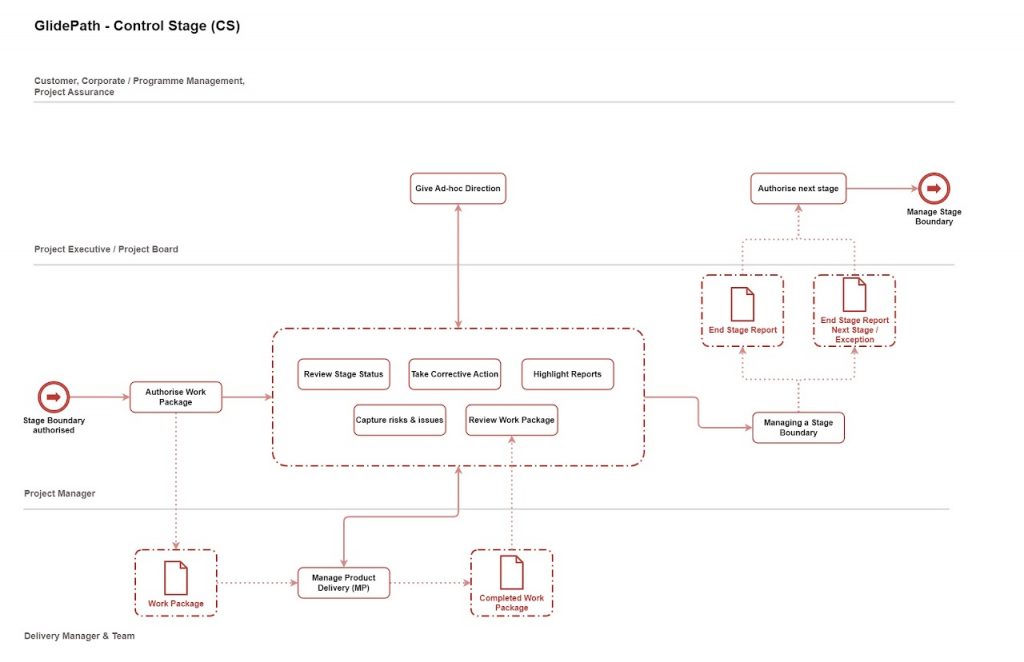
Purpose
The Control Stage process is the day‑to‑day management of a project stage. It is where the Project Manager and delivery team do the bulk of the delivery work, repeating the same activities until all planned products for the stage are complete. The aim is to deliver stage products within the agreed resource and financial budgets and timescales, keeping risks and issues within tolerances while pursuing the expected benefits.
Process flow
The sequence of activities are:
- Authorize the Work Package (WP) to the project delivery team.
- Monitor progress on WP using Checkpoint Report.
- Review the completed WP by the Project Manager. There are two possible outcomes of this step (a) approve the completed WP and authorize the next WP, or (b) assess and resolve issues and send the WP back to the project delivery team.
- Review the stage status. The stage is reviewed against the initial plan to ensure that it is within tolerance.
- Report the progress/ completion of the stage to the Project Board using Highlight Report.
Once all the products for a particular stage have been completed, the Project Manager will start preparing for Managing a Stage Boundary process.
- Authorise the Work Package (WP). The Project Board (or Project Manager, where delegated) issues the WP to the delivery team, setting scope, tolerances, timescales and resources.
- Monitor progress on the WP. The delivery team reports progress via Checkpoint Reports. The Project Manager uses these to assess progress against the WP and stage plan.
- Review completed WP. The Project Manager reviews the finished WP. Outcomes:
- Approve the WP and authorise the next WP; or
- Identify issues, require corrective action, and return the WP to the delivery team.
- Review stage status. Regularly assess the stage against the stage plan and tolerances. If tolerances are forecast to be exceeded, consider escalating to the Project Board and prepare an Exception Plan if required.
- Report to the Project Board. Provide Highlight Reports to summarise stage status, key risks and decisions. When all stage products are complete, begin preparing for the Manage a Stage Boundary process (or project closure if this is the final stage).
The complete flow of activities is repeated for each stage in the project. At the end of the last stage, the Project Manager will begin preparing for project closure
Inputs
These activities repeat for each stage of the project. At the end of the final stage the Project Manager prepares for project closure.
- Authorisation to start the next stage
- Stage plan
- Other documents from the Project Initiation Documentation (PID)
Key Deliverables
- Issue Reports: Introduction, impact, urgency, solution options, decision and action plan
- Checkpoint Reports: current and next reporting period, timescale, tolerance status, issues and risks
- Highlight Reports; status summary, reporting periods, change request and lesson log
- End Stage Reports; review of the business case, project objectives, stage objectives, team performance products, risks and forecasts
- Exception Plan; cause of exception, consequences of deviation, options, recommendation, lessons and major risks