
Purpose
Defines how the Team Manager and delivery teams plan, execute, control, and hand over product work packages using Agile techniques for sprint-based delivery.
Agile techniques are leveraged within the Manage Product Delivery process to enhance flexibility, transparency, and team ownership. By structuring delivery into time-boxed sprints, teams can focus on delivering small, valuable increments (Work Packages) with clear Definition of Done and acceptance criteria. Agile ceremonies such as sprint planning, daily stand-ups, sprint reviews, and retrospectives provide regular feedback loops that improve estimation accuracy, surface risks early, and foster continuous improvement. This iterative approach enables adaptive planning and faster response to change while maintaining governance through formal authorisation and review gates.
Ensures work packages are derived from the Project Work Package Structure (WPS), sized to sprint cadence, committed by the delivery team, and delivered with predictable quality and traceability, and employed where:
- Projects where product work is delivered iteratively in time-boxed sprints.
- Single or multi-team delivery requiring decomposition of the WPS and coordination across teams.
Roles and Responsibilities
| Role | Responsibilities |
| Team Manager / Delivery Manager | Accountable for WP decomposition, sprint planning, prioritisation, and coaching teams in Agile and product management. |
| Delivery Team | Estimates, commits to, and delivers WPs within sprints; ensures quality and definition of done. |
| Product Owner | Prioritises backlog items and accepts delivered increments. |
| Scrum Master (recommended) | Facilitates Agile ceremonies, removes impediments, supports continuous improvement. |
| Project Manager | Maintains overall project schedule, manages dependencies and integration, escalates cross-team issues. |
Inputs
- Authorisation of WP from the Project Manager
- WP with all the requisite details about the product, quality, tolerance, frequency of checkpoint reports and timeline
Objectives
- Derive each Work Package (WP) from the overall Work Package Structure (WPS).
- Size WPs to fit the sprint cadence (optimally 2 weeks to 1 month).
- Have the delivery team produce estimates and commit to scope.
- Embed quality and configuration management in every delivery loop.
- Review progress at product and stage level—then repeat the loop.
When to Use
- Whenever delivery is performed iteratively using sprints.
- When governance requires explicit authorisation, review points, reporting, and stage boundary control.
- For multi-team products where the larger WBS must be distributed across teams whilst retaining integration discipline.
Process Flow
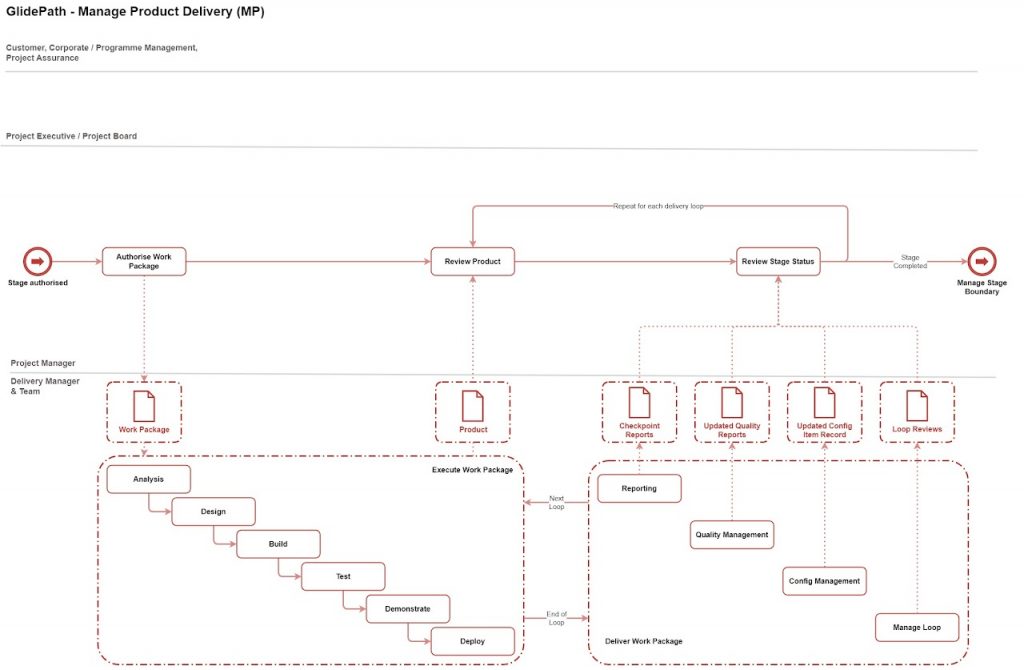
Swimlanes and Key Steps
Project Manager:
- Authorise Work Package: Confirm scope, constraints, acceptance criteria.
- Review Product: Assess delivered increment against acceptance criteria.
- Review Stage Status: Review progress, issues, risks; decide next delivery loop or stage boundary.
Delivery Manager & Team:
- Prepare & Agree WP: Derived from WPS; sprint-sized; Definition of Done (DoD) and tests defined.
- Execute Work Package (Sprint): Follow phases: Analysis → Design → Build → Test → Demonstrate → Deploy.
- Deliver Work Package: Produce increment ready for review; capture evidence; handover as required.
- Manage Loop: Reporting, quality & configuration updates; sprint review and retrospective for continuous improvement.
Inputs and Outputs
Inputs
- Work Package Structure (WPS): Overall product scope decomposition.
- Authorised Stage / Stage Plan: Timebox, tolerances, milestones, governance expectations.
- Definition of Done (DoD) and Acceptance Criteria: Quality bar and evidence requirements.
- Team Capacity & Skills: Availability and capability for sprint planning.
Outputs
- Product Increment: Potentially releasable output produced by the sprint.
- Checkpoint Reports: Progress, forecast, issues, risks, dependencies.
- Updated Quality Reports: Test results, defects trend, acceptance evidence.
- Updated Configuration Item Records: Versioning, environments, release notes, traceability.
- Loop Reviews: Sprint review and retrospective outcomes; improvement actions.
Controls and Sprint Exploitation Rules
Work Package Derivation & Sizing
- Derive every WP from the WPS; maintain traceability WPS → WP → increment → acceptance evidence.
- Size WPs to fit a sprint (optimally 2 weeks to 1 month), including ceremony time.
- Split large WPs by value or acceptance criteria, not just by activity.
Estimates, Commitment & Learning
- Estimates produced by the delivery team using their chosen method.
- Team commits to sprint scope based on capacity and prior velocity.
- Track plan vs actual; adjust estimating heuristics after each sprint.
- Use delivery evidence (defects, rework, flow) to improve predictability.
Quality Management (Within the Loop)
- Quality is built into the sprint through DoD, testing, reviews, and acceptance evidence.
- Maintain updated quality reports per sprint.
- Demonstrate working capability and acceptance evidence meaningfully.
Configuration Management (Within the Loop)
- Maintain clear records of changes each sprint: versions, environments, release notes.
- Update configuration item records as part of delivery, not afterwards.
- For multi-team work, agree integration checkpoints and shared definitions of done.
Multi-Team Delivery
Distribution of the WBS
- Partition large WBS elements across teams with clear ownership.
- Define dependencies early and treat them as planned backlog items.
- Maintain consistent cadence and terminology across teams.
Coordination & Integration
- Use coordination forums (e.g., Scrum of Scrums) for cross-team risk and sequencing management.
- Agree integration checkpoints and acceptance criteria per increment.
- Include integration evidence in the definition of done.
Capability and Resourcing
Delivery Manager (Team Manager)
- Accountable for delivery outcomes and maintaining the delivery loop.
- Requires product management skills, Scrum experience, and coaching ability.
Scrum Master (Recommended)
- Facilitates ceremonies and cadence.
- Removes impediments and improves team flow.
- Supports continuous improvement and estimation discipline.
- Allows Delivery Manager to focus on product outcomes and stakeholder engagement.
Templates and Checklists
Work Package Checklist
- Traceable to WPS element and stage objective.
- Acceptance criteria and Definition of Done defined.
- Sized to fit the sprint (including ceremony overhead).
- Dependencies identified and planned.
- Quality evidence expectations stated.
Sprint Loop Report (Minimum Set)
- Committed vs delivered items with variance explanations.
- Checkpoint summary: progress, forecast, key risks/issues.
- Quality summary: defects, test status, acceptance evidence.
- Configuration summary: versions, environments, release notes.
- Loop review actions: improvement items and owners.
- Loop Report (Minimum Set)