
Purpose
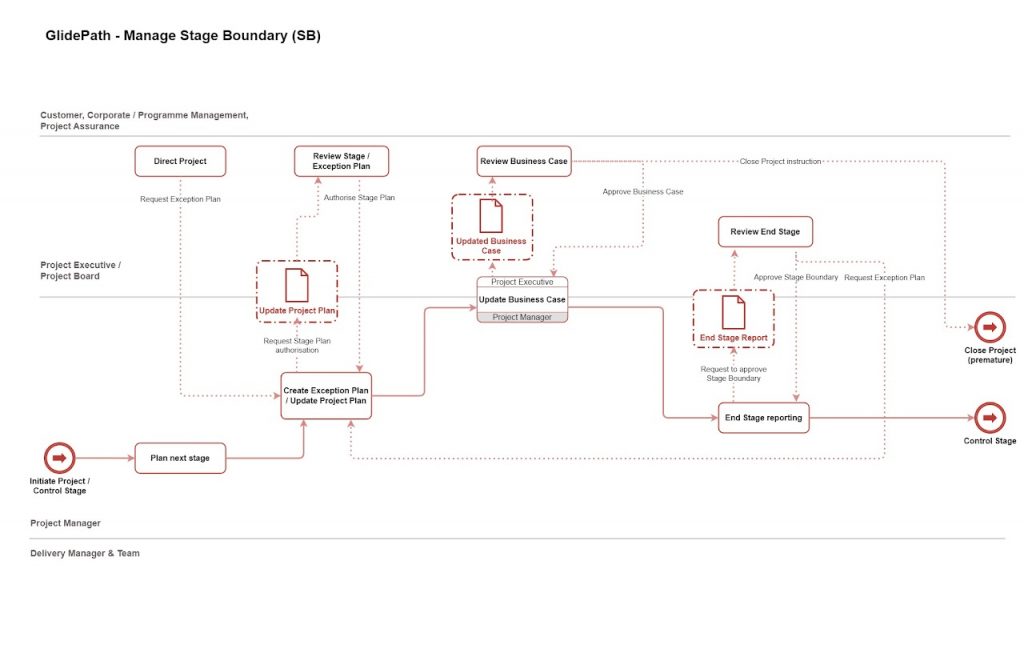
Purpose The Manage Stage Boundary process provides the Project Board with the information it needs to:
- review the performance of the current management stage;
- decide whether to authorise the next stage;
- review and update the Project Plan; and
- confirm that the business justification remains valid and that known risks are acceptable.
Following the Board’s review it may either approve the next stage, request replanning, or approve an Exception Plan to complete the current stage within revised tolerances.
Process flow
Process flow The main steps are:
- Update the Next Stage Plan: The Project Manager revises the next stage plan and the Project Plan to reflect actual performance, updated estimates, and any new assumptions. This includes product descriptions, schedule, resource requirements, tolerances and controls.
- Prepare an Exception Plan (if required): If the current stage is forecast to exceed its tolerances, the Project Manager prepares an Exception Plan that explains the cause, consequences, options and a recommended course of action. The Project Board is notified of the deviation and asked to approve the Exception Plan if required.
- Update the Business Case: Revise the Business Case to reflect new costs, benefits, risks and any changes in viability. This update accompanies either the approved next stage plan or an approved Exception Plan.
- Produce the End Stage Report: The Project Manager compiles the End Stage Report to summarise stage performance against plan, including delivery of products, team performance, lessons learned, risk status and forecasts.
- Submit for Project Board decision: Submit the Next Stage Plan (or Exception Plan), the updated Project Plan and the End Stage Report to the Project Board so it can authorise the next steps: approve the next stage, approve an Exception Plan, request further replanning, or close the project.
Inputs
- Output documents from Controlling Stage
- Stage Plan
- Project Plan
- Exception Report
Key Deliverables
- Next Stage Plans; stage plan, product description, schedule, assumptions, control, tolerance, and lessons
- Exception Plan; cause of exception, consequences of deviation, options, recommendation, lessons and major risks
- End Stage Reports; review of the business case, project objectives, stage objectives, team performance products, risks and forecasts
Notes and good practice
- Provide the Project Board with clear, concise summaries and the evidence it needs to make timely decisions.
- Keep all registers and plans current so the Board can assess performance against baselines.
- Tailor the level of detail and formality to the project’s scale and risk profile: smaller projects benefit from lighter‑touch documentation; larger projects require more rigorous evidence and controls.
- Treat the Exception Plan as a formal record of deviation and the agreed route to recover or close the stage.