
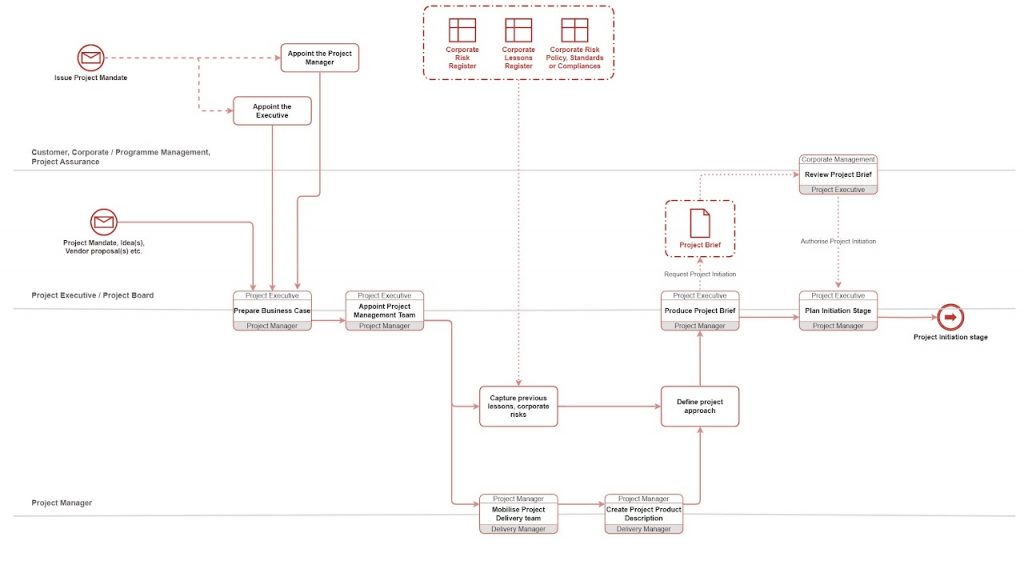
Purpose Overview
This process establishes the initial governance and documentation required to confirm the justification for a proposed project and to plan the Initiation Stage. It ensures projects only proceed when the sponsor, project team and stakeholders agree the project is viable and prioritised.
Trigger
The process is triggered by a Project Mandate (for example: a customer RFP, an internal directive, or selecting the next item from the corporate programme/demand backlog).
Key Steps
- Issue the Project Mandate and its origin. This triggers the SU process.
- Appoint the Project Executive (Sponsor) – is the internal sponsor accountable for the business case, benefits realisation and overall project success.
- Appoint the Project Manager to coordinate planning and team setup.
- Draft the Business Case to demonstrate organisational justification. The Business Case will be reviewed at each stage boundary.
- Appoint the Project Management Team: minimum: Executive + Project Manager. Add Senior Users and Senior Supplier(s) where required.
- Create Project Product Descriptions to define high-level scope and use cases for each product/deliverable.
- Capture Lessons from previous projects; where formal lessons records do not exist, interview recent project participants and document key lessons to avoid rework.
- Define the Project Approach – confirm build vs buy, internal vs external resourcing, pilot vs full implementation, cloud vs self-managed hosting, and tailorable governance. Document implications for scope, schedule, cost and quality.
- Produce the Project Brief that summarises context, rationale, objectives, benefits, constraints, high-level scope and key stakeholders.
- Review and Agree the Project Brief to confirm baselines for benefits, scope, time, cost, quality and risks with the Project Management Team and relevant stakeholders.
- Plan the Initiation Stage Plan that outlines activities, resources, schedule and budget for the Initiation Stage (mandatory prior to incurring significant costs).
Key deliverables
Project Brief (mandatory) — short, standardised document used for stakeholder review and prioritisation.
Until this stage discussion about the project may have been held over meetings, phone calls or workshops. The development of this document serves to pull together the high-level overview of the project, to be shared with potential stakeholders for discuss, debate and further develop the project parameters and characteristics. This exercise serves to ensure that effort and costs are mimimised by not launching into a full-scale project kickoff prematurely. By using a standard project brief template, competing projects can more more easily compared, prioritised and even cancelled if they are deemed unsuitable. Key elements of this artefact include:
- Business Case — to be maintained and reviewed at each stage boundary.
- Project Product Descriptions — high-level product scope and acceptance criteria.
Initiation Stage Plan (mandatory) – detailed plan for the Initiation Stage, including budget and timescales.
Given the extensive amount of work required to deliver this stage a comprehensive plan is required to cover the period, which could run to a number of weeks or even months – and incur significant expenditure for larger or more complex projects. This plan is the prelude to the project plan and only outlines the characteristics budget and plan for the Initiation Stage.
Stakeholder Relationshop Organiser (optional, subscribe to get access)
This organiser is a useful tool for anyone involved in issuing the project mandate to begin to capture the list of stakeholders that may influence or impact the project. An initial list would be particularly useful for the project sponsor(s) to have over to the project management team once they are appointed. See the guide on Stakeholder Management to address stakeholder issues on your projects.
Financial Evaluation (optional, subscribe to get access)
It is common for projects to be launched by a corporate project management office or on foot of proposals received from third parties. The financial evaluation provides a basis to capture some high-level budgetary forecasts and/or compare options for possible project approaches.
Practical Guidance and Tips
- Appoint the sponsor and Project Manager as early as possible.
- Use the Project Brief template to enable consistent comparison and prioritisation across competing proposals.
- Actively apply lessons learned to chosen approach and resourcing decisions.
- Clearly mark mandatory documents and approvals to prevent premature spend.